

State drift
The model of the mission no longer matches what is physically installed, available or degraded.
Integrated habitats, autonomous robotics and mission intelligence — designed for Earth-based integration, testing and progressive qualification.
Engineering programme pillars — not released Mars performance specifications.
SPACECRAFT DELIVERS. ROBOTS BUILD. HABITATS SUSTAIN. MARSNET KEEPS THE MISSION STATE COHERENT.
It will succeed or fail as a system of systems: autonomous equipment, delayed human oversight, changing configurations, scarce resources and mission-critical knowledge sharing the same physical reality. The dangerous gaps appear between components — when state is stale, authority is unclear, or one subsystem silently assumes another is healthy.
The model of the mission no longer matches what is physically installed, available or degraded.
Each subsystem works locally, but the handoff between power, habitat, robot, crew or logistics breaks.
A machine can act, but nobody can quickly prove whether it should act, who approved it, or how to recover.
MarsNet does not replace flight computers, robot firmware, PLCs, safety controllers or mission control. It sits above native control as a mission-state, evidence and authority layer — connecting heterogeneous systems without pretending they are one controller.

Motor drives, BMS, PLCs, robot controllers, e-stop, STO, local interlocks and subsystem safety keep ownership of hard real-time behaviour.
LOCAL · FAST · FAIL-SAFEConfiguration, inventory, health, task state, location, freshness, uncertainty and dependency state become shared mission objects.
PERSISTENT · VERSIONED · PROVENANCEDPermissions, inhibit conditions, escalation, operating envelopes and any required approval gates remain explicit before intent becomes action.
BOUNDED · REVIEWABLE · REVERSIBLEExpected versus observed outcome, anomalies, repair history, test evidence and validated recovery remain attached to the mission object.
TRACEABLE · COMPARABLE · REUSABLEStructures, modular habitat concepts, materials, fabrication, assembly and Earth-side engineering validation form the physical development layer.
Mission state, digital thread, robotics coordination, evidence, bounded autonomy and scoped authority form the mission intelligence layer.
Physical infrastructure and mission intelligence are developed together, then taken through Earth-based integration and qualification gates.
Tasks, constraints, configuration, unresolved unknowns and engineering history survive shifts, robots and mission phases.
Every important run becomes structured evidence: expected state, observed state, deviation, action, result and recovery path.
Knowledge crosses robots and habitats only after compatibility, reproducibility and authority gates are satisfied.
Robotics, habitats, ISRU, power and life support keep native controllers while exposing a common mission-semantic layer.
Human language or planning output becomes an intent delta against current governed state instead of rebuilding context from scratch.
Reasoning capability never silently becomes permission. Recommendation, bounded execution, promotion and override remain separate states.
A settlement is treated as coupled systems with explicit owners, interfaces, failure boundaries and proof gates. The question is not whether each subsystem works alone — it is whether the mission can remain safe and recoverable when one assumption, resource or interface fails.
| System layer | Current basis | Critical interface | Failure question | Next proof gate |
|---|---|---|---|---|
| Transport & cargo | Mission manifests are architecture inputs, not fixed public performance claims. | Delivered configuration → offload sequence → verified surface inventory. | Can the mission still identify, locate and use critical capability after partial delivery or offload failure? | Trace every critical item from manifest state to verified surface location, condition and readiness. |
| Surface robotics | Construction, logistics, inspection and maintenance are separate operational capabilities. | Robot-local control → shared task state → independent inspection → recovery. | What happens when one robot, tool, sensor or communications path becomes unavailable? | Repeat a real workflow with safe stop, degraded-fleet mode, recovery and complete event evidence. |
| HABIBI habitat | Earth geodesic fabrication lineage exists; Mars pressure architecture remains a qualification programme. | Structure ↔ pressure boundary ↔ thermal/shielding ↔ penetrations ↔ service access. | Can a local leak, deformation, thermal fault or service failure be detected, isolated and repaired without losing the habitat? | Full-stack assembly, pressure/leak, thermal-cycle, isolation and maintainability demonstration. |
| Power & life support | Critical-load and resource-loop logic is defined without pretending final hardware selection is complete. | Generation/storage ↔ thermal ↔ atmosphere ↔ water ↔ emergency reserves. | Which loads and resource loops remain safe under generation loss, storage depletion or compound fault? | Named critical-load/resource register plus endurance and contingency runs on the selected hardware stack. |
| ISRU & materials | Local mass begins in shielding and non-critical roles; survival paths remain independent until proven. | Feedstock quality ↔ energy cost ↔ robot throughput ↔ inspection ↔ fallback stock. | If local production stops or drifts out of quality, can the mission continue without crossing a survival boundary? | Repeatable coupon-to-part quality with traceability, acceptance criteria and safe loss-of-ISRU case. |
| MarsNet / MetaCore | State, evidence, authority and deployment tooling are Earth-testable now. | Native controllers ↔ adapters ↔ mission objects ↔ policy gates ↔ authorized decisions. | Can context be lost, stale or contradictory without the system silently acting on the wrong world model? | Measured Earth pilot showing lower context reconstruction and faster recovery without weakening hard safety or scoped authority / governance. |
Value, timestamp, source, freshness, confidence, configuration identity and unknown state.
Observe, recommend, execute, inhibit, approve, escalate or promote — each as a distinct permission.
Safe stop, isolate, rollback, substitute, repair, retest and who owns the next decision.
Expected result, observed result, raw evidence, deviation, validation status and provenance.
A robot unloads cargo. Another inspects the habitat. A construction platform prepares the site. Power availability changes. A sensor goes stale. An ISRU process drifts. Earth is minutes away. MarsNet is designed for the operational layer between these events — where one machine’s state changes another machine’s safe next action.
The goal is not “more autonomy.” The goal is a surface system that remains observable, recoverable and governable as autonomy increases.
survey · prepare · assemble · align · verify
identify · move · stage · inventory · recover
observe · compare · classify · escalate · retest
isolate · service · replace · prove · release

The MetaCore AI persona team interprets mission state. Human-form field coordinators turn approved intent into bounded fleet tasks. Specialist robots carry out the work and return evidence.
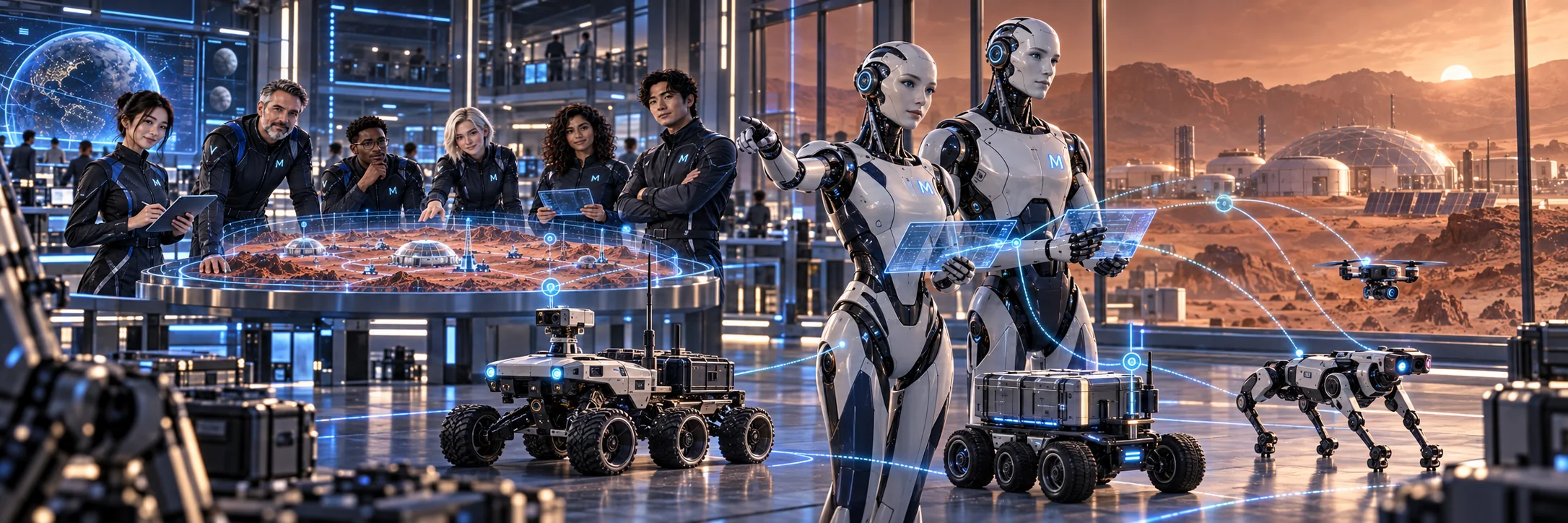
Six specialist perspectives connect system context, risks and evidence into a proposed next move for human review.
Context · planning · verificationHuman-form coordinators supervise the local scene, dispatch approved tasks and watch fleet health and exceptions.
Tasking · monitoring · escalationRovers, cargo bots, inspection units and drones work within their own controller limits and report observed results.
Local safety · execution · evidence
HABIBI is a modular habitat architecture informed by GEODOMAS Earth dome engineering. The transferable value is not “a dome that already works on Mars.” It is the engineering discipline behind repeatable geometry, indexed parts, assembly logic, sealing practice, integrated services and maintainability.
The Mars version begins where Earth evidence stops: cabin pressure differential, low external pressure, thermal cycles, radiation strategy, dust, anchoring, fire/toxicity, service penetrations and robotic maintenance all require their own calculation and qualification chain.
triangulated load path · nodes · anchoring · stability
continuous airtight layer · penetrations · isolation · leak control
insulation · external mass · thermal bridges · heat rejection
air · water · power · sensors · replaceable modules
inspection points · indexed fasteners · service routes · recovery access
build state · test history · anomalies · repair · release status
Earth engineering lineage: GEODOMAS has documented Ø8 m / 50 m² and Ø11 m / 95 m² dome families plus the Ø9 m / ~61 m² GEO-EDU-09 glazed system. These references support fabrication, geometry, assembly and systems-integration experience. They are not evidence of a Mars pressure vessel.
Transfer rule: geometry and manufacturing knowledge may transfer; qualification does not. Every Mars-critical function must close its own evidence gate.
Credible habitat development starts by separating engineering lineage from Mars qualification. Earth dome experience can shorten the path on geometry, fabrication, assembly and service integration. It cannot waive the new pressure, thermal, radiation, dust or logistics environment.
Documented GEODOMAS product families include Ø8 m / 50 m² and Ø11 m / 95 m² membrane domes, plus the Ø9 m / ~61 m² GEO-EDU-09 glazed system.
Part indexing, geometry control, node logic, assembly sequence, sealing discipline and integrated building systems provide a real Earth-side engineering baseline.
HVAC, ventilation, electrical distribution, lighting, access and maintainability experience informs how habitat subsystems occupy and interact with the physical shell.
The crew pressure boundary is a continuous, inspectable engineering system. A terrestrial transparent façade or membrane is not promoted into a Mars pressure solution by analogy.
Low external pressure, thermal cycling, radiation strategy, dust, fire/toxicity, anchoring and local shielding loads require their own models, material evidence and tests.
Members, nodes, seals and penetrations need machine-readable identity, controlled closure states, inspection evidence and recoverable service access.
The Mars habitat structure is treated as a controlled optimisation problem: define the load envelope, lock material truth, resolve global geometry, design the nodes, separate the pressure boundary, close the mass budget, then correlate analysis with physical tests.
Self-weight, handling, assembly, maintenance and Earth environmental cases are separated from Mars-specific pressure, thermal, shielding, anchoring and degraded-support cases.
Members and nodes are checked together for axial force, bending, buckling, eccentricity, bearing, fastener behaviour, fatigue, tolerances and service interfaces.
Frame, nodes, fasteners, pressure interfaces, shielding supports, penetrations and assembly hardware remain separate mass accounts. A lighter member is useless if the joints or tooling get heavier.
Density, modulus, strength, fatigue basis, thermal expansion, environment limits, temper/process and joining route are tied to the analysed configuration.
The families below are screening candidates, not released HABIBI materials. Final selection belongs to the exact geometry, pressure architecture, thermal environment, joining method, corrosion strategy, fire/toxicity requirements and test evidence.
| Function | Candidate family | Why it enters the trade | What can reject it |
|---|---|---|---|
| Long frame members | 6xxx aluminium extrusion families | Extrudability, corrosion resistance, mature structural joining options and favourable specific mass for repeatable profiles. | Insufficient buckling margin, local bearing, fatigue basis, thermal distortion, weld/HAZ implications or unavailable qualified temper/profile. |
| High-load machined nodes | Higher-strength aluminium families, including selected 7xxx routes | Potential specific-strength benefit where compact machined nodes dominate mass. | Stress-corrosion sensitivity, toughness, joining restrictions, galvanic interfaces, surface protection, fatigue or manufacturing evidence. |
| Threads / wear interfaces | Stainless or titanium inserts where justified | Wear resistance, thread durability and local interface robustness. | Mass penalty, galvanic couple, thermal mismatch, cost or unnecessary complexity. |
| Selected secondary members | FRP / composite candidates | Potential directional stiffness, corrosion resistance and mass advantage for specific load paths. | Anisotropy, creep, joint behaviour, damage visibility, thermal/vacuum compatibility, fire/toxicity or missing qualified material data. |
| Pressure boundary | Separate metallic, polymer/composite liner or hybrid architecture | Allows airtightness and pressure cycling to be solved independently from the outer shielding / assembly geometry. | Leak growth, permeation, penetration design, fatigue, repairability, compatibility, fire/toxicity and qualification complexity. |
Pressure resistance is not declared from a pretty dome shape. It is built from a continuous pressure boundary, controlled penetrations, known support conditions and testable failure modes.
Geometry, supports, contacts, imperfections and load combinations are versioned; mesh sensitivity and reaction balance are checked before reuse.
Nodes, fasteners, penetrations and support interfaces receive local analysis where global member stress can hide concentrated effects.
Measured strain, displacement, preload, leak and failure behaviour are compared with prediction before the model earns reuse.
Mission → requirement → geometry → material → part → build → calibration → test → event → decision stays traceable in the same digital thread.
The visual sequence below represents three engineering states of the same programme: robotic construction, instrumented internal systems, and autonomous inspection / service. Each state remains connected to configuration, evidence and recovery logic.

Indexed parts, alignment, preload/torque evidence, inspection access and recoverable assembly states.
Structure, pressure boundary, thermal stack, penetrations, services and instrumentation remain separate engineering objects.
Robots inspect, maintain and recover systems inside bounded authority while hard safety remains local and explicit.
Atmosphere, water, thermal control, food, waste and power are coupled inventories. MarsNet does not reduce them to a single “closure percentage”; it tracks what exists, what is consumed, what is recovered, what is contaminated, what is reserved and which failures can propagate across loops.
O₂ / CO₂ / pressure / scrubbing / storage / leakage / contingency.
Question: how long can the crew remain inside the declared safe envelope after a loop fault?potable / hygiene / process / condensate / waste / quality / reserve.
Question: which volume is safe, recoverable, isolated or contaminated right now?heat sources / rejection / insulation / storage / temperature zones / degraded modes.
Question: which loads must move when generation, radiator or circulation capacity is lost?stored supply / production / lighting / nutrients / contamination / yield uncertainty.
Question: how much mission dependency has actually been earned by the production system?hazard class / recoverable value / treatment / storage / by-product quality.
Question: can failure be isolated without poisoning another resource loop?generation / storage / critical loads / reserve floor / shedding / recovery energy.
Question: which resource loops become unsafe first under a power deficit?Measure inflow, outflow, losses, storage state and confidence continuously enough to detect drift before reserves disappear.
A failed pump is not only a pump fault if it changes thermal rejection, water availability or atmosphere control. Cross-loop consequences become explicit.
Reserve power, spare filters, clean water, purge capability and repair access are operational resources, not background assumptions.
Recovery or recirculation percentages belong to a named hardware stack, test duration, operating envelope and verification report.
Dates, crew size and vehicle cadence are programme inputs. MarsNet treats readiness as evidence: the next risk class opens only when the previous system state has demonstrated the required behaviour, recovery and maintainability.
survey · offload · power · communications · robotic work zones
Exit: repeatable remote operations + recoverable site faults.pressure · atmosphere · water · thermal · reserves · isolation
Exit: endurance + contingency + evidence review.procedures · maintainability · emergency response · bounded autonomy
Exit: stable operations + critical single-fault response.additional habitat · production · local materials · fleet growth
Exit: scale preserves redundancy, inspection and authority boundaries.MARSNET ENGINEERING LAB · EXPEDITION PREPARATION STACK
Cargo manifests, robot fleet build-up, material decisions, crew simulation, MetaCore OS synchronisation and bounded autonomy are treated as one lab stack: each step has a controlled mass budget, roles, a power envelope, acceptance evidence and a clear no-go.
The transport interface is intentionally open. Vehicle payload volume and delivered-mass limits must come from the selected mission architecture at design freeze. MarsNet does not treat a public launch-vehicle estimate as a frozen engineering input.
Basis: comparable Earth geometry / fabrication lineage exists in the documented GEODOMAS Ø8 m / 50 m² family.
Basis: MarsNet architecture class for multi-zone habitation, lab or production functions.
Basis: expansion architecture for shared operations, medical, coordination or large common volume.
Structure, nodes, pressure boundary, services, shielding support, fit-out, consumables, tooling, spares and margin are controlled separately.
Mass release rule: public mass figures appear only for a named, frozen configuration with a traceable subsystem roll-up and margin policy.
The public architecture shows sequence and acceptance logic, not invented tonnage. Mass, volume and power numbers belong to a named vehicle, frozen configuration and controlled subsystem budget.
Public rule: no payload mass or power band is treated as a MarsNet performance claim before configuration freeze. The durable content is dependency order, interface definition and the evidence required to unlock the next phase.
Survey, communications, initial power, cargo localisation and robot-safe boundaries.
Anchoring, shielding/supports, protected power/control points and service access.
Atmosphere, water, thermal, reserves, pressure boundary, penetrations and isolation.
Alternate paths, spares, repair capacity, degraded modes, crew procedures and bounded autonomy.
Transport does not merely constrain total mass. It constrains part envelope, handling, centre of mass, interfaces, assembly order, tooling and the amount of recovery capability that must arrive before the habitat can exist.
Member length, panel geometry, node packaging and protected transport state must fit the selected vehicle and offload architecture.
Every major item gets lift points, robot grasp/fixture logic, centre-of-mass assumptions and a recoverable staging state.
No component may require a later-delivered tool, inaccessible interface or unsupported temporary state unless that dependency is explicitly planned.
Shipment shock, handling damage, seal contamination and configuration mismatch must be observable before the part enters a critical build path.
Exact priorities depend on crew state, environment, subsystem configuration and fault mode. MarsNet carries the declared critical-load model and makes the active shedding rationale visible.
Loads whose loss creates an immediate unacceptable hazard in the active scenario: atmosphere containment, essential thermal control, emergency medical or equivalent.
Minimum sensing, control, isolation and communications needed to understand state and execute a safe recovery.
Charging, repair tools, reserve transfer, diagnostics and other loads required to move from degraded state back toward normal operation.
Non-critical production, growth, science and construction peaks that can pause while survival and recovery loads are protected.
No universal sacred order: a MarsNet compute node, medical device, pump or heater is critical only in the context of the active hazard analysis. The system should explain why a load is protected before it acts on the priority.
A credible surface fleet is sized from work demand, travel, charging, tool change, maintenance, failure probability, reachability and required parallelism. MarsNet treats each robot as a governed mission object — not an icon on a fleet dashboard.
Enough independent capability to unload, stage and build while preserving a local safe-stop and recovery path.
The machine that performed the work is not the only source of evidence that the work is acceptable.
Habitat, power, inspection and maintenance work can proceed without one queue starving another safety-critical queue.
Critical roles continue under a declared robot/tool/communications loss case with a known fallback or reduced mission mode.
High-throughput construction, excavation, logistics or inspection where repeatability and efficiency dominate.
Variable service tasks in human-oriented environments where flexible manipulation and tool compatibility matter.
Specialists carry the repetitive mission load; generalists absorb edge cases, service work and changing interfaces.
Identity · capabilities · health · local safe stop · event emission · maintenance mode · recovery state.
Early Mars industry should not try to manufacture everything. Precision, calibration and life-critical reliability are imported first. Local production is promoted where it reduces logistics burden without introducing a harder-to-see quality or survival dependency.
Seals, electronics, medical hardware, precision connectors, robot compute, calibrated sensors and initial life-support components remain Earth-sourced until a local route proves equivalent function and quality.
Regolith shielding, berms, ballast, pads and selected secondary parts are strong first targets because local mass can help without entering the breathing or primary pressure path.
Feedstock batch, process recipe, machine/tool state, geometry, inspection, installed location and service history remain linked in the mission digital thread.
If local production stops or drifts out of tolerance, the mission retains an explicit reserve, substitution, repair or reduced-capability path.
| Readiness | Allowed role | Evidence required | Dependency rule |
|---|---|---|---|
| S0 · Characterise | Feedstock sampling and process observation. | Composition, variability, contamination modes, energy demand and measurement uncertainty. | No mission dependency. |
| S1 · Coupon | Small specimens and calibration pieces. | Repeatability, dimensions and relevant strength / thermal / chemical properties. | Laboratory or bounded field use only. |
| S2 · Secondary | Shielding, ballast, pads and non-critical secondary components. | Inspection method + replacement path + known failure mode. | Earth-supplied fallback remains available. |
| S3 · Operational | Routine non-life-critical production. | Batch traceability, process control, maintenance record and predictable throughput. | Failure may reduce capability, not survival. |
| S4 · Critical candidate | Candidate for mission-critical use. | Qualification against the actual environment, interfaces and failure modes. | Independent survival path still required. |
| S5 · Critical allowed | Mission-critical use only by formal authority promotion. | Validated performance, monitored degradation and demonstrated contingency. | Loss case remains inside the declared safety envelope. |
KSAT-1X is an internal scenario and training framework for comparing how teams make decisions under delayed information, scarce resources, conflicting priorities and incomplete evidence. It records behaviour that can be reviewed — not hidden psychological labels.

What was known, unknown, requested, ignored or assumed — and whether the team detected when its shared model became stale.
Time to recognise the problem, establish a shared operational picture, choose an action and verify the resulting state.
Whether the team preserved options, used stop conditions and avoided turning uncertainty into an irreversible commitment too early.
How quickly the group incorporated contradictory evidence, restored coordination and closed the loop after an error or degraded state.
Scope: KSAT-1X is a simulation and training framework. It does not diagnose personnel, infer clinical traits or replace professional psychological screening, medical clearance, validated human-factors testing or policy-defined mission authority held by authorized mission roles.
High-consequence decisions need a governed review process: inspectable evidence, authenticated roles, explicit mandate and scope, technical review, human-factors impact, dissent visibility and a deliberate path for revisiting decisions when assumptions change.

Intent, evidence, alternatives, objections, authority, outcome and later corrections remain in one inspectable trail.
Engineering acceptance and human-factors consequences are reviewed explicitly. Neither silently substitutes for the other.
Minority or low-power positions retain equal traceability so consensus cannot erase a technically important objection.
New evidence, changed configuration or failed assumptions can reopen a previously accepted decision without losing its history.
MetaCore OS is not a flight computer, robot operating system or safety PLC. It is the mission-state layer above native controllers: configuration, intent, events, constraints, authority, evidence and validated writeback across heterogeneous systems.
MetaCore can provide controlled access to configuration, state, evidence and constraints so advanced AI systems can support analysis and reasoning without silently acquiring operational authority.
MarsNet does not need one giant monolithic controller. It needs a shared semantic contract so heterogeneous systems can expose the pieces that matter for coordination, evidence and recovery.
What physical or software thing exists, where it is, which configuration it is in and what it depends on.
What the asset can safely do now — with prerequisites, operating envelope and known limitations.
Observed condition, freshness, source and confidence. Unknown stays unknown instead of becoming a guessed value.
Hard safety boundaries, resource limits, incompatibilities, maintenance locks and temporary mission restrictions.
Who or what may observe, recommend, command, inhibit, approve or promote knowledge for this object.
What happened, which inputs were used, expected versus observed outcome, provenance and validation status.
Known safe-stop, rollback, isolation, repair or substitution paths attached to the failure modes that matter.
Mission control sends what should change. MarsNet resolves that delta against current state, constraints and authority before anything becomes action.
MarsNet follows the MetaCore Physical AI rule: Robots execute. MetaCore learns. Humans lead. Hard real-time protection stays local. Mission-level autonomy is released only when the state, authority envelope, recovery path and evidence contract are explicit.
Collect state and evidence. No operational recommendation and no actuation authority.
Required: identity · freshness · provenanceGenerate options, consequences and uncertainty while a human or external controller retains the decision.
Required: explainability · alternatives · no silent actuationPerform pre-authorised actions when preconditions hold and inhibit conditions remain false.
Required: local safety · recovery · event evidenceCoordinate several native systems against shared constraints without taking ownership of their hard real-time safety.
Required: authority graph · conflict resolution · rollbackOnly reproducible, reviewed operational knowledge becomes available for bounded reuse beyond the original run.
Required: compatibility · approval · supersession pathServo loops, e-stop, STO, BMS cut-off, PLC safety and equivalent hard protections do not depend on a cloud service or language model.
Task, environment, tool, payload, limits, expected result, hazards and recovery path are explicit before autonomy can optimise execution.
Observed state → event candidate → context → severity/confidence → protective action → diagnosis → correction → retest.
The system can know how to act without being authorised to act. Observation, advice, bounded execution and fleet-wide promotion remain distinct authority states.
The same gate discipline used in the MetaCore robotics engineering workspace is extended to MarsNet surface operations.
A short instruction is safe only when configuration, freshness, provenance, authority and operating-envelope assumptions are still compatible. If confidence drops below the released threshold, MarsNet expands the dialogue, degrades the mode or inhibits the action path instead of guessing.
MarsNet can maintain dense multi-system state continuously. Crew attention cannot. The interface therefore compresses the world into change, consequence, confidence, options and required authority — without hiding uncertainty or flooding the operator with telemetry.
Which object, resource or constraint moved outside its previous or expected state.
Immediate consequence, affected dependencies, time-to-harm and evidence basis.
Available responses with trade-offs, reversibility, resource cost and uncertainty.
Observe, recommend, bounded execute, inhibit or require explicit approval by the policy-defined authorized role.
Show what changed, which constraint moved, what assumption became invalid and which systems are now affected.
Recommendations expose the operational reason, evidence basis, alternatives and what happens if no action is taken.
Routine telemetry stays machine-readable. Humans receive exceptions, decisions and compressed evidence ranked by mission consequence.
The interface is designed to show whether MarsNet is observing, recommending, executing inside a bounded envelope or waiting for approval.
We propose a modular Earth-based analog settlement where habitats, robots, power, life-support interfaces, ISRU experiments, crew operations and MarsNet can be tested as one coupled system. Not a theme park. Not a Mars-equivalence claim. A place to expose integration failures while recovery is still cheap.
The site becomes a persistent systems laboratory: every habitat, robot, power node, valve, task, anomaly and repair is represented in the mission digital thread. The physical configuration changes; the engineering history remains traceable.

Use real controllers, robots, structures and power hardware — or high-fidelity surrogates — with configuration, calibration, events and operator actions captured.
Inject bounded power, sensor, leak, delay or robot/tool faults without turning the campaign into an uncontrolled hazard.
A run closes only when the system reaches a known safe state, evidence is reviewed and the next run can be compared.
GEODOMAS-derived Earth structures for assembly, sealing, thermal, service-access and human-operations experiments.
Construction, logistics, inspection and maintenance with safe-stop, degraded-mode and independent verification.
Generation, storage, critical-load control plus progressively connected water, atmosphere and thermal interfaces.
State, authority, evidence, digital thread, anomaly history and human-machine operating interface across the site.
Local-material experiments, QC, procedures, handoffs, delayed guidance and contingency drills share the same evidence model.
Each campaign crosses multiple subsystems and ends with a reconstructable evidence packet. The objective is to discover which interfaces, assumptions and recovery paths fail first — while the cost of failure is still acceptable.
Cargo → staging → assembly → inspection → sealing → acceptance. Measure handoffs, interventions, recovery and evidence completeness.
Combine bounded power loss or communication latency and verify load shedding, local authority, continuity and recovery.
Inject an Earth-safe fault and observe detection, isolation, crew/robot coordination, repair and re-verification.
Run long enough for maintenance debt, stale assumptions, configuration drift, production fallback and human handoff problems to appear.
Member, node, seal, penetration and sector tests correlate structural, deformation and leak models.
Indexed parts, tolerances, torque/preload evidence and repeatable assembly/disassembly campaigns.
Bounded communications, sensor, power and workflow faults validate safe-stop, recovery, escalation and knowledge promotion.
The system performs inside the declared envelope with enough evidence to support controlled reuse.
Behaviour cannot yet be explained, reproduced or separated from configuration / instrumentation ambiguity.
A failed assumption is useful when it is discovered on Earth before crew, flight hardware or mission cadence depend on it.
| Build stage | Physical scope | Primary question | Promotion gate |
|---|---|---|---|
| A0 · Instrumented cell | One bounded workflow: robot, subsystem or habitat interface. | Can MarsNet reconstruct state and evidence without weakening native safety? | Comparable baseline/repeat runs with useful operational delta. |
| A1 · Integrated yard | Multiple robots + habitat subsystem + power/control interfaces. | Do cross-system handoffs remain observable and recoverable? | Fault campaigns close with traceable recovery and no hidden authority transfer. |
| A2 · Analog settlement | Habitat cluster, resource loops, mission control, crew procedures and local-material experiments. | Can the stack operate as one system over persistent time? | Stable operations, maintenance discipline and validated degraded modes. |
| A3 · Isolation campaign | Selected-duration crew/operations campaign with communication delay and bounded external support. | What fails when context, fatigue, maintenance and uncertainty accumulate? | Independent review of safety, human factors, recovery and evidence quality. |
Evidence boundary: an Earth analog can validate integration methods, procedures, interfaces, software, maintainability and selected environmental cases. It cannot by itself prove Mars radiation, low-pressure external environment, gravity, dust chemistry or flight qualification. Those remain separate test domains.
Choose one real robot, subsystem or autonomy workflow. Freeze the baseline, define acceptance criteria and safety boundaries, connect MetaCore, repeat comparable runs and measure whether the operational delta is real.
Robot, simulator, SDK, telemetry or habitat subsystem.
Acceptance criteria, permissions and safety boundaries are explicit.
Comparable task, declared configuration and evidence captured on every run.
Recovery time, human interventions, state reconstruction, repeat faults and validated knowledge reuse.
This is an example validation cadence, not a fixed commercial promise. The schedule compresses or expands with hardware access, safety constraints and the maturity of the existing telemetry/control interface.
Freeze configuration, map states/events, define authority boundaries, collect representative runs and quantify present recovery/context costs.
Add the MetaCore state/evidence layer, repeat the same workflow, inject bounded faults and verify that native safety remains independent.
Review deltas, failed assumptions, operator workload and reusable knowledge. Decide what is worth productising — and what should be rejected.
Success criterion: not “the AI looked smart.” The pilot succeeds only if comparable evidence shows a useful operational delta without weakening native safety, operator understanding, configuration control or accountability.
The architecture is useful only if it reduces operational ambiguity without taking away native safety or human accountability. The proposition is deliberately falsifiable: compare the same workflow with and without the layer.
Persistent configuration, task state, authority, evidence, recovery history and validated operational knowledge across heterogeneous systems.
Flight software, PLC safety, e-stop logic, drives, BMS protections and certified subsystem controllers remain native and explicit.
Same task, declared baseline, equivalent hardware state and measured differences in recovery, interventions, reconstruction and repeated diagnosis.
Start where context is repeatedly lost between people, machines or runs — and where better state continuity would be operationally visible.
MarsNet combines three Earth-side workstreams that can already be inspected separately: physical habitat engineering, Physical AI / remote execution infrastructure, and long-horizon mission context with evidence and authority control. Mars is the integration target — not an excuse to skip validation.

Geodesic geometry, fabrication, assembly, envelopes, glazing, insulation, HVAC, electrical systems and maintainability provide physical-system experience on Earth.
Useful lineage; Mars-critical functions remain separately qualified.Remote execution, stateful work objects, event evidence, safety gates, operational knowledge promotion and bounded automation form the machine-operation layer.
Designed to sit above — not replace — local deterministic safety.Habitat, robot, cargo, resource, authority and recovery state become one digital thread for cross-system coordination and role-governed decision support.
Earth-testable integration hypothesis; Mars deployment requires its own qualification chain.Persistent context, memory continuity, explicit values and decision history explored as long-duration collaboration problems.
Research framing; not autonomous mission authority.Crew, habitat, robotics, resource loops and physical dome-engineering experience begin to converge into one operational problem.
Simulation and Earth lineage do not equal Mars qualification.Bridge APIs, remote execution, evidence/provenance controls and Physical AI engineering converge into an Earth-testable mission-state architecture.
Next step: comparative validation on real robotics and habitat workflows.MetaCore LAB separately explores long-horizon human–AI collaboration, trust calibration, cognitive workload, team coordination and psychophysiological signals where measurement is appropriate and ethically governed.
This lane remains experimental until effects are reproducible under defined protocols. It does not override life-support, robotics safety, engineering evidence, medical standards or policy-defined mission authority.
Robotics OEMs, habitat teams, research groups and mission architects can start with one workflow — or help build the Earth Analog Settlement. The first objective is not a giant partnership announcement. It is one technically honest integration problem with a baseline, a safety boundary and a measurable result.
One robot, subsystem or workflow. Baseline → connect → stress → compare.
Habitat, robotics, power, resource-loop or instrumentation partner for the integrated proving ground.
Structures, pressure architecture, autonomy boundaries, digital thread or interface review.